
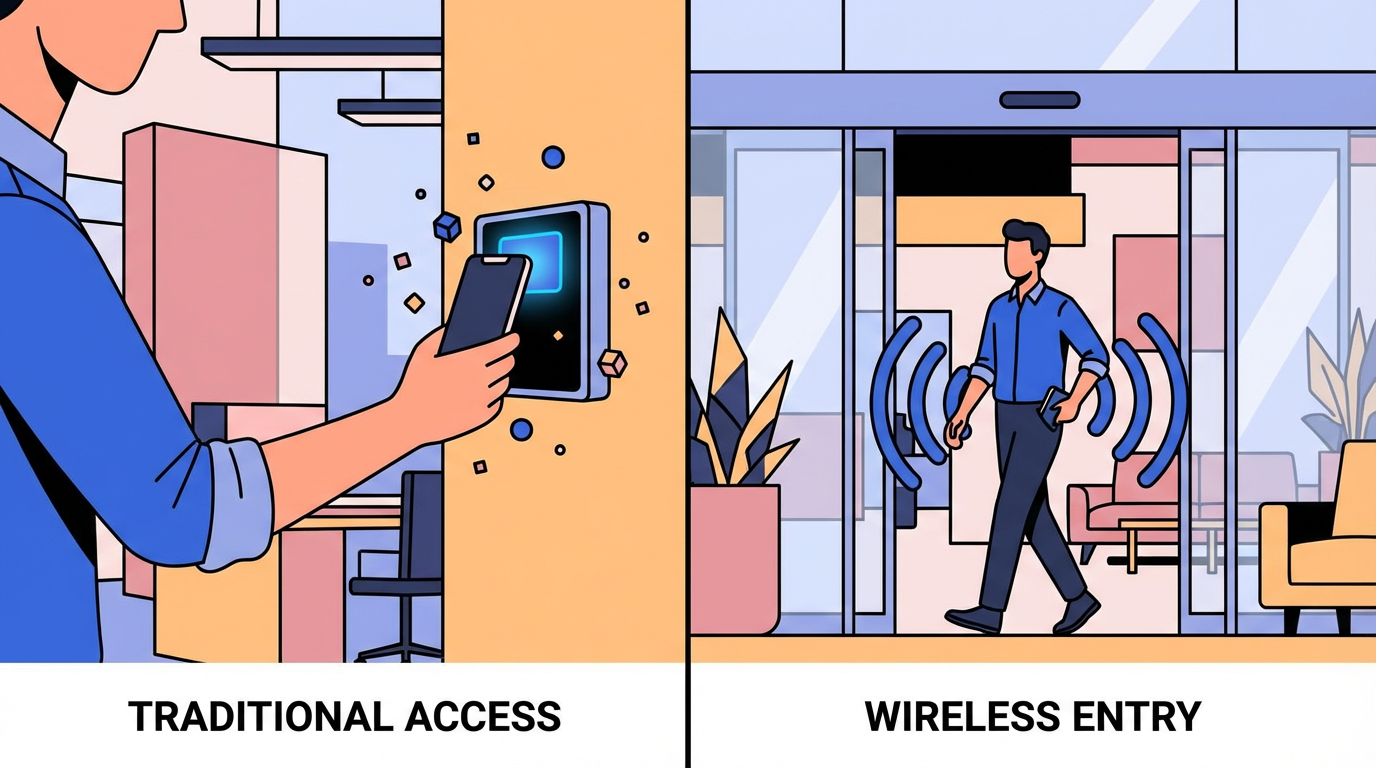
NFC fits intentional tap access, while Bluetooth fits hands-free entry at busy doors.
For most small businesses, NFC is more consistent for door access, while Bluetooth fits busy entry points, reflecting the short-range NFC vs longer-range Bluetooth tradeoff. The convenient choice depends on whether you want a deliberate tap or a walk-up unlock.
The convenience gap: tap vs. walk-up unlock
Mobile credentials are digital IDs on phones or wearables that replace plastic badges and can be managed from a central admin console.
NFC works by a tap within about 1.5 inches, so access happens when the user intends it. Bluetooth Low Energy can unlock from several feet away, letting the phone stay in a pocket or bag.
If you need proof of presence at a specific door (think cash office or HR file room), NFC's tap is harder to trigger by accident. Bluetooth can be tuned to require an extra action, but that trims the hands-free benefit.
Front-office doors, payroll drop boxes, and manager-only spaces usually benefit from intentional taps. Loading docks, hands-full staff, and ADA access lean toward hands-free.

Where each tech saves real time in a small business
Time savings show up at shift change. If 25 employees enter twice a day and hands-free BLE saves even 10 seconds per entry, that's about 8 minutes per day—roughly 3 hours a month you get back.
Admin time drops when credentials can be issued or revoked remotely instead of printing cards or waiting on office staff.
For seasonal hires, sending a credential by email before day one can avoid a 15-minute badge stop. Ten temps in a month is about 2.5 hours saved and fewer payroll delays.
For payroll accuracy, that remote control helps with role changes and terminations; you can stop access the minute a shift ends instead of at the next badge run.
Reliability, security, and support reality
NFC's very short range reduces accidental reads and interference, while Bluetooth's longer range can be more sensitive to nearby devices and building materials.
Security isn't just the radio tech; it's device hygiene. Enforce passcodes, encryption, and remote wipe so a lost cell phone doesn't become a lost door key.
Mobile credentials can also pair with phone biometrics, which helps reduce shared badge behavior and keeps access tied to the right person.
Convenience can flip in metal-heavy or noisy RF areas, so test the busiest doorway before committing.
Key takeaways
- Choose NFC for high-intent access points where you want a clear tap.
- Choose Bluetooth for hands-full workflows like deliveries or cart movement.
- Choose both for mixed-use buildings—tap for secure zones, hands-free for main entries.
- Confirm reader compatibility and upgrade path before you buy; many systems already accept NFC or BLE.
Start with a 30-day pilot on one exterior door and one interior door, then track missed-punch corrections and manual unlocks before rolling out.


Share:
Time Attendance Only vs. All-in-One Access Device: Single Function or Integrated?
Onboarding in 2026: Plastic Card vs. Face Scan – Which Is Cooler?