
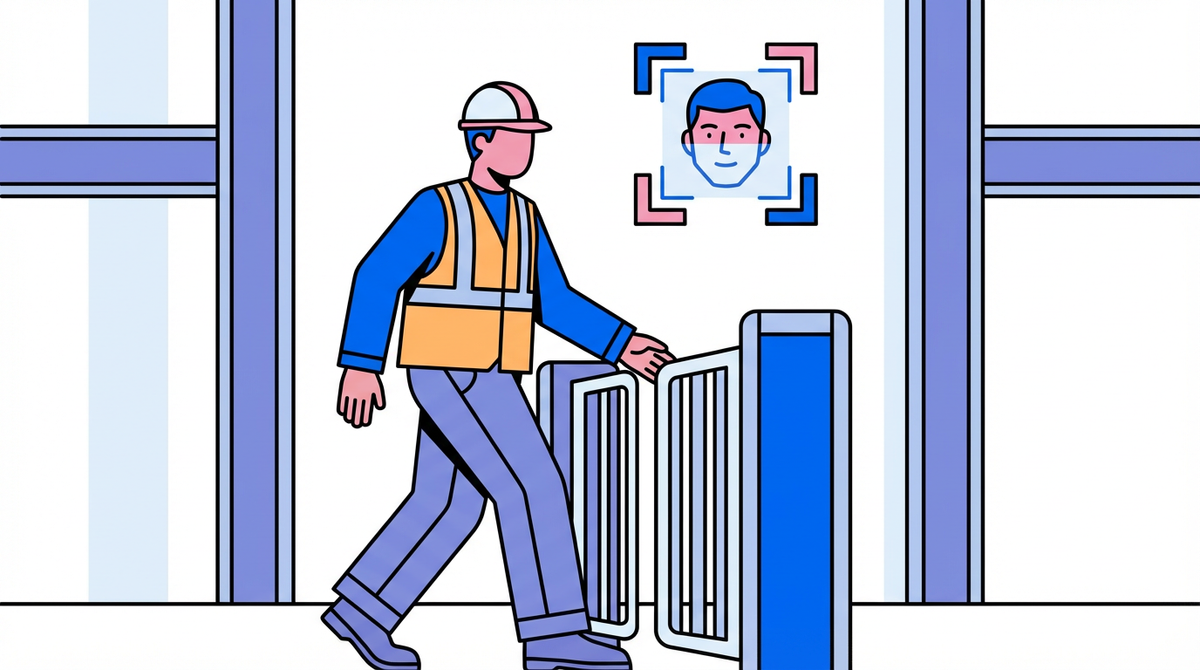
Face turnstiles can tighten identity-based attendance on construction sites when workflow, payroll integration, and privacy are handled up front.
Ever had a crew stack up at the gate while someone tries to read yesterday's handwriting, only to chase missing signatures after shift end? On sites I've supported, moving off paper has quickly reduced payroll cleanup because the check-in happens when people actually show up. You'll get a practical way to apply face-based entry so attendance, access, and payroll stay aligned without slowing the crew.
Real-name attendance and face turnstiles in plain terms
In many jobsites, construction workforce management software ties attendance to access control and real-time site visibility, so real-name attendance works best when the entry point becomes the clock-in. In practice, real-name attendance means the system records a worker's identity at entry, and a face turnstile blends a physical gate with facial verification so the gate itself becomes the record. On a one-gate project, that record can double as your headcount for a safety huddle before tools hit the ground.
With manual time and attendance in construction, errors, time theft, and slow cleanup are common, especially when crews move across the site and paperwork stacks up. For example, if 60 workers submit paper cards and it takes 5 minutes to verify each, that's 5 hours of admin time before payroll even starts, and that time grows when handwriting is unclear.
Where face turnstiles pay off fastest
When face recognition-based attendance is used to stop proxy attendance, meaning one worker clocking in for another, the gate quickly becomes the single source of truth. A reported rollout across 80 sites for 10,000+ staff shows the approach can scale across multiple crews and locations without losing centralized control.
Modern digital attendance tracking can materially shorten payroll processing while improving real-time visibility into crew activity for staffing decisions. One report notes a 30% reduction in payroll processing time; if a weekly payroll run takes 10 hours, that's about 3 hours back, and those hours often land where payroll errors used to hide.

Designing the workflow on site
Gate flow and enrollment
Construction workforce management guidance points to assessing needs, validating integrations, and piloting before scaling, and that matches what works in the field. On projects I've supported, starting with one primary entrance clarifies peak throughput, staffing for shift starts, and how subcontractors should be enrolled. On a 200-worker job, a two-week pilot at the main gate usually tells you whether a second lane is needed.
Coverage beyond the gate
For areas beyond a fixed entrance, mobile time tracking with geofencing can fill the gaps and push job codes and overtime data directly into payroll systems. If crews split between a main yard and a remote trench line, use face turnstiles at the yard and mobile check-ins for the field crew, then reconcile both feeds into a single timesheet so hours are not double-counted.
Privacy and trust you can't ignore
Public opinion on workplace face recognition is mixed, and Americans' views on workplace face recognition show strong concern about errors and fairness. Pew found 45% favor using it for attendance while about a third oppose, and about half expect workers to be misidentified or recognized unevenly by skin tone, so adoption improves when you keep the purpose narrow and avoid any suggestion of facial expression analysis.
The FTC's best practices for facial recognition emphasize privacy by design, clear notice, and meaningful choice. Post signage at entry points, collect affirmative consent during onboarding, limit use to attendance, keep data only as long as needed for payroll and audits, and give workers a simple way to correct a missed scan.

Pros and cons in one view
Moving from paper to automation reduces manual cleanup that comes with paper attendance systems. For example, if a supervisor reviews 300 punches a week and each correction takes 2 minutes, that's about 10 hours of rework that could be avoided when the gate captures the record at entry.
Pros |
Cons |
Stronger identity verification at entry helps stop proxy attendance and reduces disputes. |
Worker trust and perceived accuracy risks must be addressed up front. |
Faster payroll processing and cleaner records reduce admin drag. |
Consent, notice, and data-retention rules add governance work. |
Real-time visibility supports staffing decisions across sites. |
Setup and change management are heavier than paper systems. |
Face turnstiles are a good fit when the pain is real-name accountability, payroll delays, or multi-site visibility, and they fail when trust and integration are treated as afterthoughts. Start with a small pilot, wire it into payroll, and make privacy rules plain to everyone who walks through the gate.


Share:
How to Use Smart Attendance Data to Optimize Scheduling and Cut Overtime
Cloud Attendance vs. Traditional Clocks: How to Choose in 2026?