
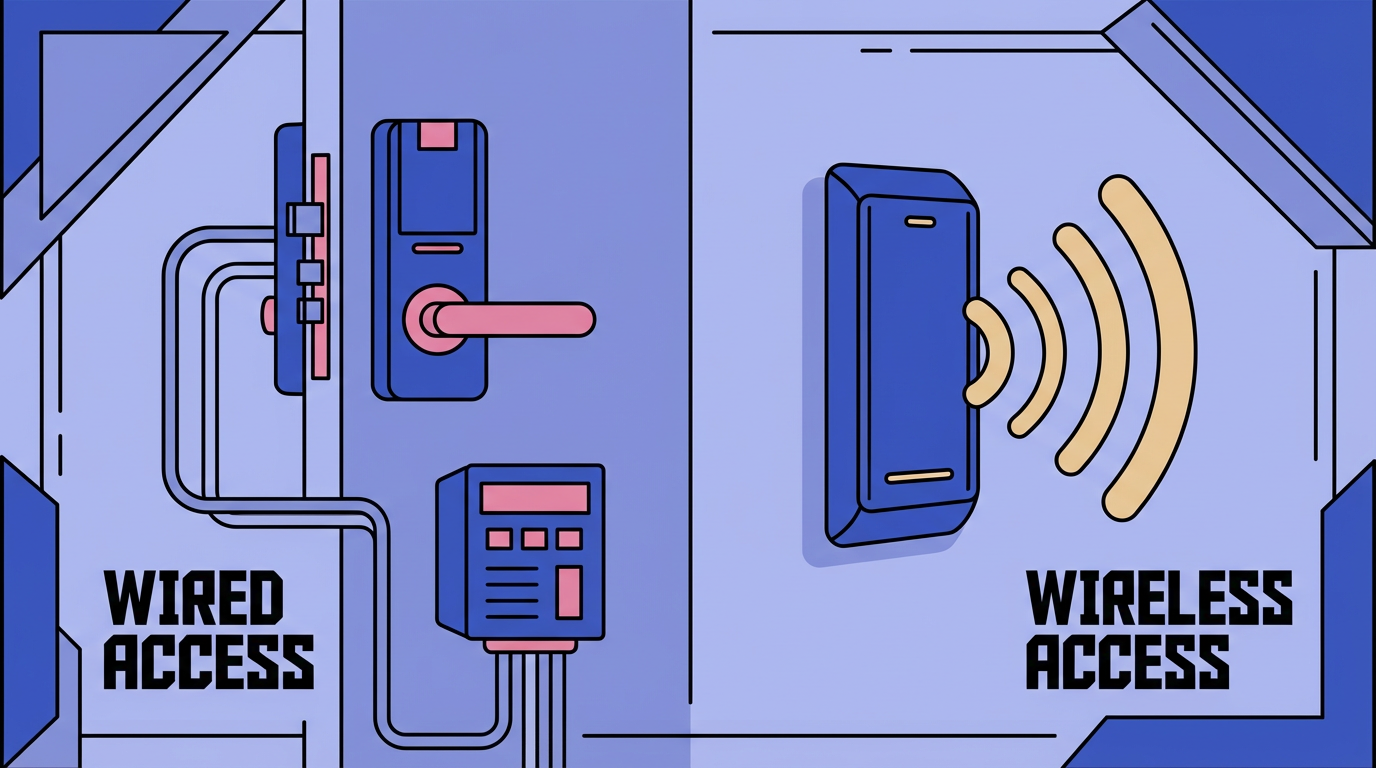
This article compares wired and wireless access control for small businesses, focusing on stability, installation impact, and practical use cases.
Is your morning already a sprint and the front door still will not open for a delivery? A wireless setup can be installed faster with less wiring work and adjusted later without re-cabling, so upgrades do not hijack the workweek. You will leave with a clear way to choose the approach that fits your space, your comfort with risk, and your daily workload.
What access control means for a small business
Access control sets who is authorized to enter, when they can enter, and which zones they can access. In a 10-person shop, that can mean everyone uses the front door while only managers and the bookkeeper can enter the cash office after hours.
In building controls, wired systems communicate over physical cables, while wireless systems use short-range signals to avoid running new wire. For access control, that difference shows up in how readers and locks talk to the controller, not in whether you can set schedules or permissions.
Stability: what keeps doors working every day
Wired systems have long-proven stability, and wireless performance has been comparable over the past 3–4 years when the environment is right. In operations, I still treat signal conditions as the make-or-break variable, so I plan a quick on-site test before committing. If the back hallway is concrete and metal shelving, that test tells you whether a repeater or extra access point is needed.
Wireless systems can be affected by walls, metal, or electronics and they rely on batteries, so the maintenance plan is part of the uptime plan. The same risk profile includes higher exposure to jamming or hacking, which is why strong encryption matters. I fold battery and signal checks into a regular safety walk so a rarely used door does not become the surprise failure point.
Installation and disruption: choosing the least painful path
Retrofit versus new construction is a key decision point for wiring versus wireless choices. If you lease a 2,000 sq ft suite with finished walls, the disruption of pulling new cable can outweigh the upside of a fully wired build.

Wireless installs are faster and require less specialized wiring labor, which makes them practical in retrofits or when trades are booked out. Wireless zones can be reconfigured in software without rewiring, so you can change access when teams or tenants move. When a storage room becomes a new office, access can be reassigned without opening walls.
Standalone electronic systems are unwired and quick to install, while online electronic systems are wired to centralized software for real-time monitoring and integrations. A single rear delivery door may justify a standalone lock, while a clinic with multiple doors and alarms benefits from centralized oversight.
Use cases that match time and payroll realities
Attendance clarity and payroll confidence
Access control platforms capture entry and exit events, which helps attendance tracking when time sheets look off. If a temp worker says they clocked out on time but the door log shows a later exit, you can resolve the discrepancy in minutes instead of chasing stories.

Flexible spaces and changing layouts
Wireless is often favored in tenant fit-outs, warehouses, parking areas, and outdoor spaces where reconfiguration is common. When you move cages, change traffic flow, or add a new bay door, wireless hardware can follow the layout without a new cable pull.
Centralized control for complex sites
Online electronic systems connect to centralized software and integrate with alarms and elevators, which suits sites that need coordinated control across multiple doors. If your office spans two floors with a server room and a reception vestibule, centralized control keeps permissions consistent when roles change.
Pick wired when you need maximum stability and deep integrations, and pick wireless when speed, flexibility, and minimal disruption keep the business moving. Whatever you choose, treat access as an ongoing process, not a one-time install, so doors never become the bottleneck in a tight payroll week.


Share:
Time Attendance Only vs. All-in-One Access Device: Single Function or Integrated?
Onboarding in 2026: Plastic Card vs. Face Scan – Which Is Cooler?