
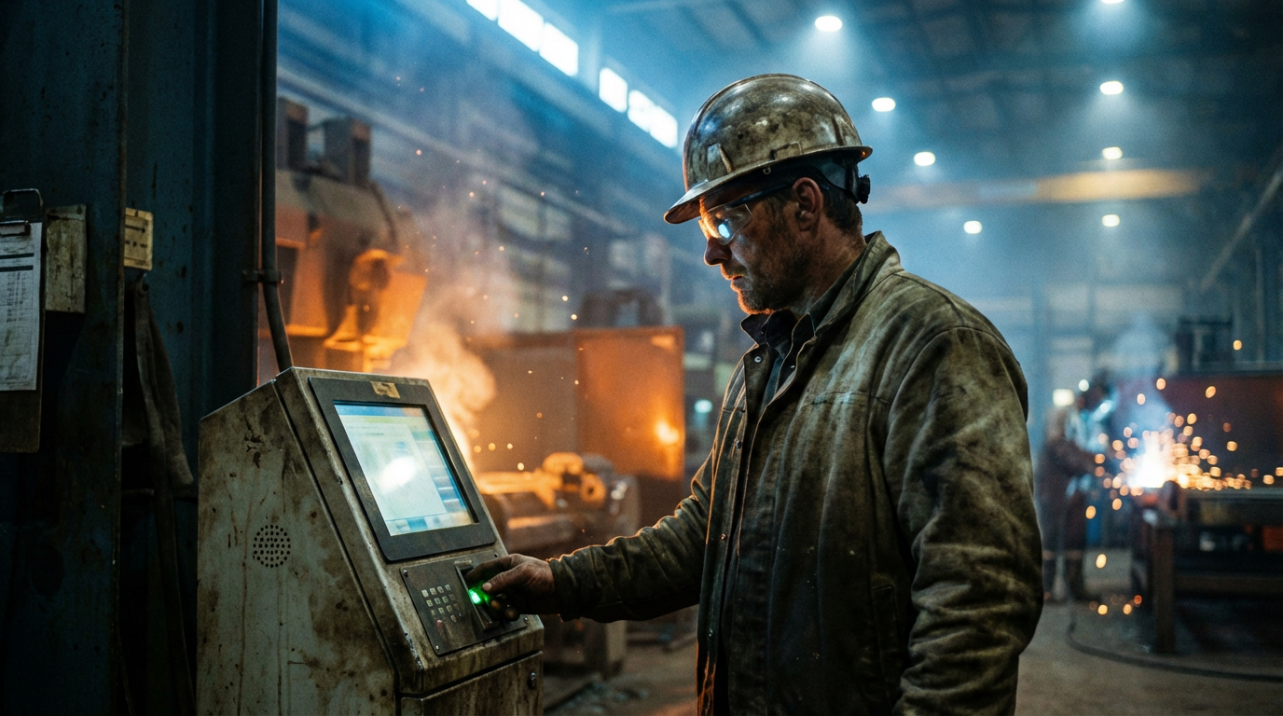
Summary: Biometric time clocks and access controls are moving from carpeted offices to hot, dusty, wet production floors—and new durability standards are emerging so they actually work where your people do the work.
From Office-Grade to Factory-Grade Biometrics
Biometric tech is no longer limited to airports and smartphones; biometric technologies are rapidly gaining adoption across sectors, including manufacturing. That shift is replacing badge swipes with fingerprints, face, or palm for timekeeping and access.
The catch is that many plants are still using office-grade devices. Put those next to a punch press or wash bay and you get smudged sensors, misreads, frozen screens, and a lot of manual overrides.
Operationally, every failed punch turns into a timecard correction, a supervisor investigation, and a potential payroll dispute. Multiply that by dozens of workers and shifts, and the “cheap” device quickly becomes expensive.
If you are running welding, machining, food processing, or pharma lines, your biometric tech needs to be specified like any other industrial control—not like a lobby kiosk.
What “Durable” Now Really Means
Manufacturing and medical device engineers have long used structured life-cycle testing to harden sensors; those lessons from manufacturing systems for biometric design are now showing up in biometric hardware.
On the floor, “durable” is no longer a vague promise. It usually means:
- Rated against dust and water so it survives spray-downs, not just a light wipe.
- Tested across realistic temperatures, from cold dock doors to hot furnace areas.
- Resistant to oil, metal dust, and cleaning chemicals that coat hands and surfaces.
- Designed to work with PPE: gloves, shields, masks, and hair nets.
One independent study found that high humidity alone could swing fingerprint error rates by more than 20% between products. That is the difference between a smooth shift start and a line of frustrated operators at the time clock.
If 40 people lose 3 minutes each at shift start because of bad reads, that is 120 minutes of lost productive time per day. At $25.00 fully loaded labor per hour, you are burning about $50.00 per day—or roughly $13,000.00 per year—because the device cannot handle your environment.
Lab accuracy numbers on datasheets rarely match real-world performance next to a welding booth or blast freezer.

Designing Biometric Workflows for Tough Conditions
Durability is not just hardware; it is workflow. In Industry 4.0 environments, biometrics for Industry 4.0 applications tie identity to machines, lines, and quality records—but only if workers can authenticate when and where they need to.
When I walk a plant, I look at three things before recommending a biometric rollout:
- Where the device physically sits: near doors that slam, forklifts, wash-down spray, or direct sunlight.
- When workers interact with it: at shift-change rush, in the middle of a batch, or in emergency access cases.
- What workers are wearing: gloves, masks, safety glasses, ear protection, or full suits.
From there, you can redesign the flow. You might move the reader a few feet out of the spray zone, add a small hood, switch a high-dirt station from fingerprint to face or palm, or create clean-hands stations near clock-in points.
Enroll workers under conditions that look like reality, not like a conference room demo. Systems perform better when enrollment and verification happen under similar environmental conditions, which directly reduces misreads and rework.
How to Evaluate Vendors and Set Your Own Standard
For small and mid-sized manufacturers, you do not need a 50-page spec, but you do need a simple, non-negotiable checklist. As industrial vendors lean into biometric technology in manufacturing, use this to keep them honest:
- Ask for written operating ranges (temperature, humidity, dust and water rating) and test methods, not just marketing claims.
- Require a pilot on your toughest line or area for at least one full shift cycle, including nights and weekends.
- Track concrete metrics in the pilot: failed attempts, manual overrides, missed punches, and time spent fixing records.
- Confirm support for a backup path (badge or PIN) that maintains security while keeping production moving if sensors fail.
- Make durability part of your ROI case by including downtime, admin time, and payroll corrections, not just hardware price.
If you treat biometric readers like any other piece of production equipment—with defined requirements, realistic testing, and clear maintenance—you are more likely to end up with systems that survive your environment, tighten access, and clean up time and payroll data instead of creating new headaches.


Share:
Coworking 3.0: Automated Zone Access Based on Membership Tiers
Modular Upgrade Trends: Why “All-in-One” Boxes Are Yielding to Scalable Components