
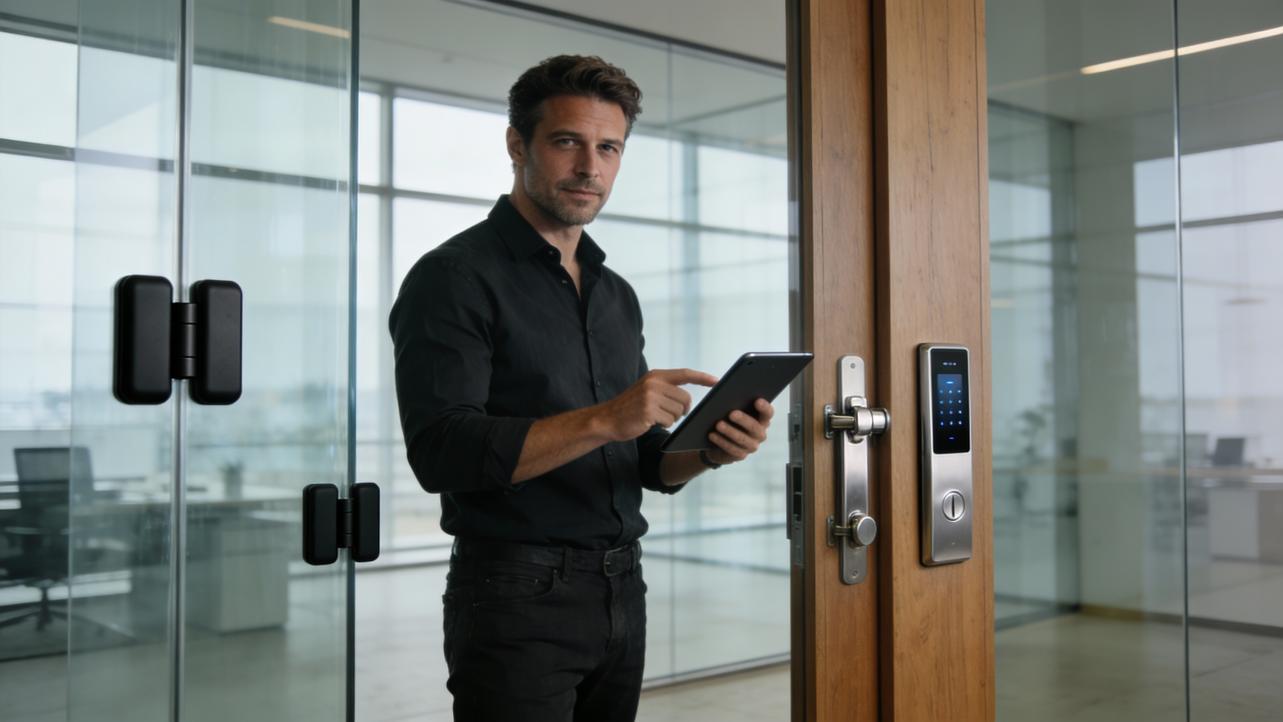
Glass doors make an office feel open, modern, and welcoming. They also create headaches if you choose the wrong lock: doors stuck open during a power outage, staff waiting in the hallway when a reader glitches, and supervisors fixing timecards because people could not badge in on time.
From an operations point of view, your question is not “Which lock is coolest?” but “Which lock keeps people and payroll flowing while still satisfying security and safety rules?” As someone who gets called when access control is hurting productivity, I look at magnetic locks and electric bolt–style locks through that lens first, and hardware specs second.
This article walks through how each option behaves on office glass doors, where each shines, and when one is a liability. I will tie the comparison to real-world use, draw on security guidance from manufacturers and security companies, and give you concrete scenarios so you can pick the right direction for your space.
The Two Lock Types In Plain English
Before we compare, it helps to pin down what we are talking about on glass doors specifically.
Magnetic locks, often called maglocks, use an electromagnet on the frame and a metal plate on the door. When powered, the magnet holds the plate with significant force, keeping the door shut. According to Allwin Architectural Hardware and access control vendors like Avigilon, maglocks are popular on high‑traffic commercial doors because they are durable, support keyless operation with cards or codes, and integrate cleanly with access control systems without bulky mechanical hardware on the glass.
Electric bolt locks are electromechanical locks that extend a solid metal bolt into a strike when locked and retract it electronically when a valid credential is presented. Functionally they behave like the deadbolt and mortise locks described by Aorbis, CRL, and other commercial hardware manufacturers, but driven by power instead of a manual thumb turn. On glass doors they are usually housed in a patch or header so the glass itself is not drilled through, similar to the way glass‑mounted mortise and deadbolt hardware is packaged in CRL and FHC product lines.
Both can be used on framed and frameless glass doors, and both can be wired into smart locking and access control systems like those described by Avigilon, Genea, and GetSafeAndSound. The differences show up in how they fail, how they feel in daily use, and how hard they are to mount on your specific glass.

How These Locks Actually Sit On Your Glass
Glass does not give you the same forgiving structure as a wood or metal door, so the mounting method matters as much as the lock choice.
Maglocks on glass are typically mounted along the top of the opening. The magnet sits on the frame or header, and the metal “armature plate” is attached to the glass leaf using special glass brackets. All Security Equipment notes that many glass‑door maglock kits use adhesive or clamp‑on brackets for light‑duty doors and glass cabinets, and glass‑specific brackets for full‑size commercial doors, so you avoid drilling directly through the glass. For frameless office partitions, that is a big aesthetic win.
Electric bolt locks on glass usually hide inside a top rail, floor box, or a surface‑mounted patch that clamps to the glass. From the outside, they may look like a slim patch lock or a small housing near the top or bottom of the door. Under the cover is the bolt mechanism and sometimes the card reader. That approach echoes what Kedao and Allwin describe for mortise and cylinder‑style glass door locks: the hardware clamps or sits in a pre‑cut opening rather than relying on a traditional wooden stile.
From a mounting standpoint, maglocks tend to put more hardware on the frame and less on the glass. Electric bolt locks shift more complexity to the door leaf or the floor, since the bolt and strike must line up perfectly every time the door closes.
To see why that matters, imagine a frameless glass conference room door that flexes slightly as people tug on the handle throughout the day. The small amount of movement is usually fine for a maglock, which just has to bring the plate in contact with the magnet. An electric bolt lock, on the other hand, has to guide a metal pin into a small strike. If the door settles or the hinges wear, that alignment can drift, leading to nuisance lock failures unless maintenance keeps up.

Security And Compliance: Will This Lock Actually Protect You?
Theft and intrusion risk is not theoretical. Aorbis cites Statista data showing more than 1,300 thefts per 100,000 people in the United States in 2023, and Deep Sentinel’s coverage of glass door security notes that about a third of burglars enter through an unlocked door or window. So the first operational question is simple: when your office is supposed to be locked, is it truly locked, especially under stress?
How Maglocks Behave Under Stress
When powered, maglocks can hold with hundreds of pounds of force. Avigilon’s commercial door guidance highlights maglocks as strong, top‑mounted devices suitable even for glass doors and storefronts, especially when integrated with badges, PINs, or biometrics.
However, maglocks are inherently “power‑dependent.” The electromagnet must remain energized to stay locked. A critical essay on IPVM goes so far as to call maglocks “fundamentally insecure” for storefront doors because most are configured to fail unlocked when power is lost, and because the author argues that some real‑world installations can be forced open by a determined person despite rated holding strengths. IPVM also points out that fire and life‑safety codes have steadily limited casual maglock use on egress doors, requiring careful integration with exit devices and fire alarms.
The code side matters operationally. Avigilon and other manufacturers stress that maglocks tied to fire alarms must release automatically during an alarm so people can exit. All Security Equipment recommends backup power like an uninterruptible power supply to keep maglocks functional during routine outages, but in a longer outage or wiring failure, a fail‑safe maglock will release. That is good for life safety, but if your office is on a busy street it may not be what you want during a storm that knocks out power.
Picture a real example. A high‑traffic glass storefront door uses maglocks for badge entry. At 4:00 PM a regional power failure trips the building, and your UPS is sized for only thirty minutes of runtime. By 4:45 PM the magnet de‑energizes and the door swings freely. Staff are still inside finishing work, but now your main door cannot be truly locked until power returns or you bring in temporary mechanical hardware. From a security standpoint you are exposed, and from an operations standpoint your manager is likely staying late to babysit the door.
How Electric Bolt Locks Behave Under Stress
Electric bolt locks behave more like the deadbolts that Aorbis and CRL recommend for high‑security doors. When the bolt is thrown, you have a solid mechanical connection into the frame or floor. Many electric bolt configurations are designed to be fail‑secure, meaning the bolt stays extended if power is lost, with a keyed cylinder or internal release as a backup. That maps closely to the way commercial deadbolts and mortise locks are used on retail glass doors and offices: mechanical first, electronic second.
Because the holding force comes from the metal bolt rather than from continuous magnetic force, once locked, an electric bolt does not rely on constant power to keep resisting force. The risk shifts from “What if I lose power?” to “What if the bolt cannot retract?” which is a different operational conversation.
That is not a free pass. On any door used for emergency egress, your life‑safety design has to guarantee people can get out quickly, which is why access control guides from Avigilon, Genea, and Lockmanage emphasize pairing electronic locks with compliant exit hardware and integrating them with fire systems. In practice, that often means electric bolt locks are used on perimeter glass doors that are not primary emergency exits, or on interior glass doors securing sensitive rooms where occupancy is low and alternative exits exist.
Imagine a data room with a glass front inside your office. You want it solidly locked when unoccupied, but nobody should be relying on that door to escape during a fire. An electric bolt lock integrated with your badge system and a mechanical override key gives you high forced‑entry resistance with controlled, auditable access, and you can design the fire plan around other exit paths.
What This Means For Risk
If you run a ground‑floor office or storefront where the glass entry is both your main entrance and an emergency exit, maglocks give you easier code paths for quick egress, but you must invest in sound power design and accept that during extended outages the door will be less secure. If you are securing a glass door that is not a primary escape route, electric bolt locks give you deadbolt‑like mechanical security and reduce reliance on continuous power, at the cost of more installation complexity.
Either way, remember Deep Sentinel’s reminder that intruders often choose the easiest entry. A locked door of either type, especially if backed by visible cameras and alarms, is a far better starting point than a pretty glass door with a weak latch.
Daily Operations: Badges, Bottlenecks, And Payroll
Security that breaks your daily flow will quietly wreck productivity and payroll accuracy. Every time I review door hardware for a small business, I ask two questions: how many people use this door daily, and what happens to timekeeping when the lock misbehaves?
Throughput And User Experience
Manufacturers like Allwin and Avigilon position maglocks as ideal for high‑traffic areas. The door swings freely once unlocked; there is no latch to ride over or bolt to retract while the door is moving. That makes entry and exit feel smooth, especially when combined with proximity readers or mobile credentials, as described in Avigilon’s and GetSafeAndSound’s guides. For office glass doors that see constant traffic, this “frictionless” feel is one reason maglocks are so common.
Electric bolt locks introduce a timed motion. The bolt must retract before the door moves, and extend into the strike when it closes. Access control guides from Lockmanage and Genea stress the need for careful alignment and calibration of electronic locks and strikes on glass; Kedao’s discussion of misalignment and jammed locks on glass doors shows that even small shifts can cause issues. In practice, if the closer is too strong or the timing is misconfigured, the door can hit the still‑extended bolt and bounce back, forcing people to pull and retry.
Now translate that into lost time. Suppose your main office glass door handles forty people, six entries or exits per person per day. That is 240 uses. If a slow‑retracting bolt or misaligned strike adds even one extra second per use because people pause or have to try again, that is four minutes a day of people standing at the door. Over a month of twenty workdays, that becomes eighty minutes of friction. It does not sound like much until you realize it tends to cluster at start times and after lunch, exactly when you want people logged in and productive, not just inside the building.
Impact On Time And Attendance
Electronic locks are deeply tied to timekeeping. Guides from Avigilon, Genea, and GetSafeAndSound highlight audit trails and event logs as benefits of smart locks and access control. When doors and readers are reliable, those logs line up nicely with your time and attendance system.
When doors are unreliable, managers start editing times manually. Lockouts or stuck doors mean employees wait outside and clock in late, or they badge twice, or they use a different entrance that does not log correctly. Every exception becomes a tiny payroll adjustment and sometimes a morale issue.
Here is where maglocks have an operational advantage on very busy doors. Their simpler mechanical behavior makes there fewer alignment‑related failure modes, especially on frameless glass doors that flex. As long as the magnet energizes and the plate makes contact, the door locks. Most problems come from power, wiring, or access control logic, which are easier to monitor centrally.
Electric bolt locks can be just as reliable when installed and maintained well, but they are more sensitive to door movement, wear, and closer settings. That is manageable if you have a good relationship with a commercial door vendor and you treat periodic inspection as part of your facilities routine, the way Kedao and Allwin recommend for glass door locks in general.
From a payroll perspective, ask yourself which failure you would rather handle: a rare outage where the maglock releases and you temporarily rely on staff presence and cameras, or occasional days when a bolt is misbehaving and employees queue at the door, generating exceptions in your timekeeping. Different businesses will answer differently.

Installation And Retrofit On Glass Doors
Most small businesses are not building from scratch. You already have glass doors, and the question is what will install cleanly without endless rework.
What Goes Into A Maglock Retrofit
All Security Equipment’s guidance on installing magnetic door locks on glass emphasizes preparation and the right fittings. For full‑size doors you will typically:
You clean the glass thoroughly, mount the glass bracket or patch to hold the armature plate, align it carefully with the magnet on the header, and run low‑voltage wiring through the frame to a power supply or access control panel. For light‑duty cabinets and displays, some maglock kits use adhesive‑backed plates, but for office entry doors you will be in the camp of mechanical brackets designed for tempered glass.
The upside is that you usually avoid major surgery on the door leaf. Mortise‑style cutting into glass is risky and specialized. With maglocks, most of the work is in the frame, ceiling space, and wiring. That aligns with the way glass hardware specialists like CRL and FHC package glass‑mounted components: they favor clamp‑on and surface‑mounted solutions for security without compromising the glass itself.
What Goes Into An Electric Bolt Retrofit
Electric bolt locks require two things that are non‑negotiable: precise alignment between bolt and strike, and a substantial mounting point to absorb the force on the bolt. On a framed glass door, that usually means installing a bolt unit in the frame or header and a reinforced strike on the door edge or floor. On frameless glass, you are often working with surface‑mounted patches or rails that clamp onto the glass and carry the load.
Articles from Kedao, Allwin, and Industrial Door Services all stress that mortise and cylinder‑style locks in glass doors call for professional installation, careful measurement of backset and glass thickness, and strict adherence to templates. Installation notes from sliding and glass door lock guides repeatedly warn that misalignment leads to jamming, difficulty locking, or reduced security.
In practice, that means an electric bolt retrofit on an existing glass storefront or interior office door is a more intricate project. You may need custom hardware from a glass specialist, coordination between your locksmith and your glass vendor, and more installation time. Once in, though, you have hardware that behaves like a commercial deadbolt with electronic brains, which can be a security win.
Thinking In Time And Rework, Not Just Parts
Here is a simple way to compare. Imagine your locksmith quotes three hours to install a maglock kit on your glass entry and six hours to install an electric bolt plus associated glass hardware. Even if the maglock parts cost slightly more, the total downtime and labor cost may still favor the simpler maglock.
Now imagine the bolt installation is not perfect on day one and requires a return trip to adjust alignment. That extra trip often happens during your business hours. Two or three employees end up managing the door by hand, and your front‑of‑house workflow suffers.
The lesson is not that bolts are “bad.” It is that their success depends heavily on installation quality. If you already have a trusted commercial door and glass partner, electric bolt locks are very workable. If you are relying on a general handyman, maglocks are usually more forgiving.

Cost, Risk, And Layered Security
Lock choice should not live in isolation. Security companies like Deep Sentinel and Vivint emphasize layered protection for glass: stronger glass or security film, better locks, electronic detection, lighting, and visible deterrents.
Deep Sentinel cites research that burglars only break glass in a fraction of window entries, roughly 5 to 15 percent of cases, largely because broken glass is noisy and risky. They also note that roughly one third of burglars walk in through an unlocked door or window. Vivint’s guidance on glass security echoes the theme that basic hardware upgrades, glass reinforcement, alarms, and cameras together make your property a much less attractive target.
Translated to an office, that means your decision between maglocks and electric bolt locks should be blended into a bigger picture that might include:
Reinforced or laminated glass on your main storefront, as Deep Sentinel describes, so a burglar cannot simply smash through regardless of lock type.
Office alarms and glass‑break sensors covering your glass entry, so any forced entry attempt creates noise and alerts.
Cameras aimed at the glass doors, as both Deep Sentinel and Vivint recommend, with motion‑activated recording and notifications to catch and deter suspicious behavior.
Proper door hardware, such as mortise locks, deadlatches, and header hardware sized for commercial use, of the type CRL and Industrial Door Services provide, so the lock is not the only thing standing between you and a break‑in.
In that layered model, the operational differences between maglocks and electric bolt locks become one slice of a risk‑management decision, rather than your only line of defense.
Side‑By‑Side Comparison For Office Glass Doors
The table below summarizes the main tradeoffs for small and mid‑size offices.
Factor |
Magnetic Locks On Glass Doors |
Electric Bolt Locks On Glass Doors |
Core mechanism |
Electromagnet on frame holds metal plate on door while powered; no mechanical latch between leaf and frame. |
Motor‑driven metal bolt extends into a strike in frame or floor, behaving like a deadbolt; bolt retracts electronically for access. |
Power and failure mode |
Typically fail unlocked when power is lost for life‑safety reasons; needs continuous power and often a backup supply, as noted by All Security Equipment and Avigilon. |
Often configured to stay locked (bolt extended) when power fails, similar to commercial deadbolts described by Aorbis and CRL; requires mechanical override and careful life‑safety design. |
Forced‑entry resistance |
Strong holding force when installed correctly, but critics on IPVM argue real‑world maglock doors can be forced and that power dependence is a structural weakness. |
Mechanical bolt offers high resistance similar to the deadbolts recommended by Aorbis and CRL for high‑security glass doors; less dependent on continuous power once locked. |
Traffic and user experience |
Very smooth for high‑traffic doors; door swings freely once unlocked; popular in busy lobbies and corridors, per Allwin and Avigilon. |
Slightly more mechanical feel; bolt timing and alignment must be tuned so users do not feel delays or jamming on entry; better suited when traffic is steady but not extreme. |
Glass mounting and aesthetics |
Magnet on frame and plate on glass using brackets; often less hardware on the glass itself, preserving frameless look emphasized by Allwin and Kedao. |
Hardware often sits in a header, floor, or surface patch on the glass; can look clean but usually more visible on the door leaf than a maglock plate. |
Installation complexity |
Wiring plus bracket alignment; generally avoids cutting into glass; often easier retrofit on existing glass doors, according to glass hardware install notes from All Security Equipment. |
Requires precise alignment of bolt and strike and solid mounting points; often needs professional glass and lock coordination, as highlighted in Kedao and Industrial Door guidance. |
Integration with access control |
Works well with card readers, keypads, biometrics, and smart systems; widely used with access platforms like those described by Avigilon and Genea. |
Integrates with the same systems; behaves like an electronic deadbolt or mortise lock, compatible with proximity and mobile credentials supported by Avigilon, GetSafeAndSound, and Lockmanage. |
Code and compliance considerations |
Fire codes often require automatic release on alarm; maglocks have become harder to use casually on egress doors, as IPVM notes, pushing more careful design. |
Treated more like conventional locking hardware with electronic control; life‑safety still critical but sometimes simpler to integrate where the door is not a primary exit. |
Practical Recommendations For Common Office Setups
Bringing this back to operations, think in terms of your layouts rather than in abstract hardware categories.
For a small ground‑floor office where the glass entrance is both your main entry and an important path of egress, I generally lean toward a well‑designed maglock system paired with good glass hardware, cameras, and an alarm. The maglock’s ability to drop open automatically when triggered by the fire system, as Avigilon describes, gives you straightforward life‑safety behavior. To mitigate the power‑loss risk that IPVM calls out, budget for a proper backup power supply and make sure your alarm, cameras, and access control can alert you if the magnet is offline.
For an interior glass door protecting a sensitive area like a finance room, server room, or HR archive, an electric bolt‑style lock tied into your access control system often makes more sense. There is no expectation that this door serves as a main exit, so you can safely prioritize robust mechanical locking, as commercial door specialists like CRL and Industrial Door Services recommend with their mortise and deadbolt hardware. Add cameras and logs, as the access control guides from Genea and Lockmanage suggest, and you now have a secure, auditable internal barrier that does not depend on continuous power to stay locked.
For a multi‑door layout with a mix of glass storefronts and interior glass partitions, do not be afraid to mix approaches. You might use maglocks on the busiest lobby glass doors for ease of flow, electric bolt locks on a few high‑risk interior glass rooms, and simpler mechanical or smart locks on conference rooms, drawing from the menu of mechanical, magnetic, and smart glass locks described by Allwin and Kedao. What matters is that your access control software and monitoring, like the cloud platforms from Genea or Avigilon, give you a single pane of glass for who can go where and when.
Short FAQ
Are maglocks “inherently insecure” on glass office doors?
Some security professionals on IPVM argue that maglocks are fundamentally insecure because they rely on constant power and often fail unlocked, and because they have seen doors forced open despite high advertised holding forces. At the same time, manufacturers like Avigilon and Allwin position maglocks as strong, durable solutions for glass doors when installed correctly and integrated with fire alarms and backup power. The real answer is that maglocks can be very effective on glass doors if your installer is competent, your power and alarm design are solid, and you accept their fail‑safe behavior as part of a layered security plan rather than your only defense.
Do electric bolt locks work with smart and mobile credentials?
Yes. Electric bolt locks are simply one form of electronic commercial lock, and access control providers such as Avigilon, Genea, Lockmanage, and GetSafeAndSound all describe systems where locks of various types are driven by keypads, cards, fobs, biometrics, or mobile credentials. On glass doors, the difference is mostly mechanical: the lock housing and bolt must be compatible with the glass hardware, and your installer must follow the glass door lock selection and installation guidance from manufacturers like Allwin, Kedao, and CRL.
Which option is better if I have no in‑house facilities team?
If you have limited technical support on staff, maglocks are usually more forgiving day to day, provided they are installed and wired correctly up front. They have fewer alignment‑sensitive moving parts on the door and behave predictably under normal power. Electric bolt locks demand more precise installation and periodic checking for misalignment or wear, as the glass lock troubleshooting sections from Kedao and others highlight. If you choose bolts, protect your time by engaging a commercial glass and door specialist rather than the lowest‑bid contractor.
In the end, your best choice is the lock that keeps your team and your time flowing with the fewest surprises. Start from your doors, your exits, and your daily traffic, layer in the security practices that Deep Sentinel, Vivint, and the commercial hardware makers recommend, and then choose the lock type that fits that picture. That is how you turn your office glass doors from a constant distraction into a quiet, reliable part of your operation.


Share:
Buying vs. Subscribing: Cost Analysis of Attendance Software for SMBs
RFID Cards vs. Mobile Bluetooth Entry: The Choice for Modern Business