
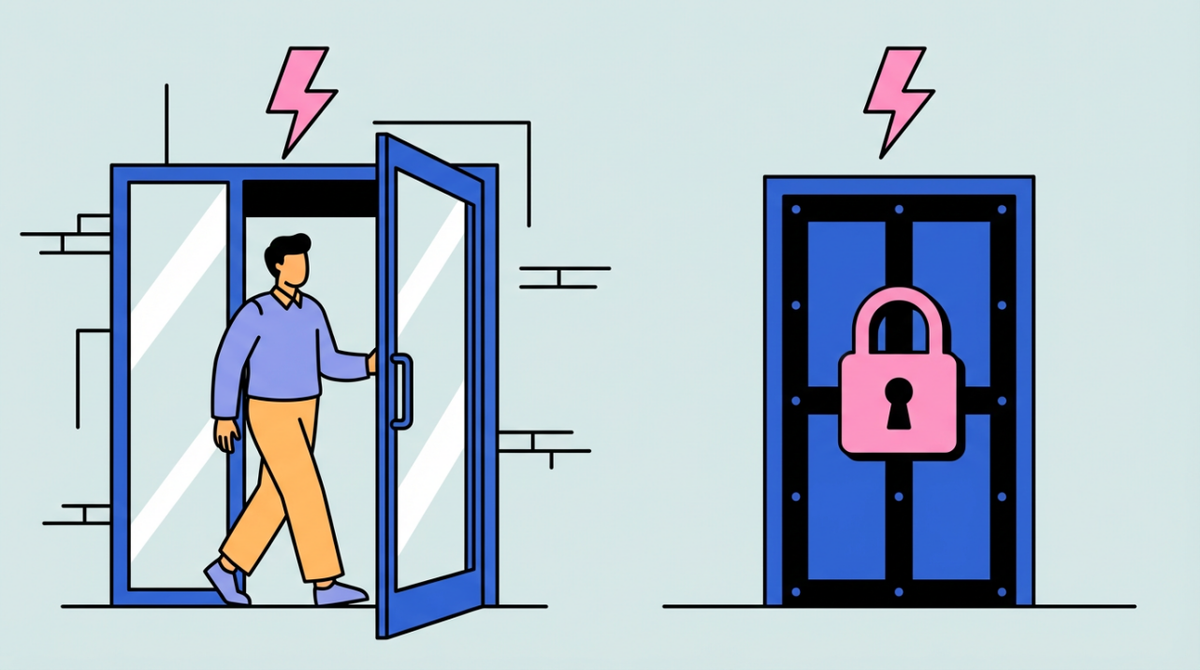
This article explains how to choose fail-safe or fail-secure locks for outages and how codes can override preference.
Power flickers right at shift change, and suddenly a door is either wide open to the street or refusing to budge while people try to leave. The right door behavior keeps staff moving safely and keeps sensitive rooms protected when the lights go out. You'll get a clear way to decide door by door so outages stop turning into security and payroll headaches.
Fail-safe and fail-secure in plain terms
Power-loss behavior in one sentence
Fail-safe means the lock unlocks when power is cut, while fail-secure means it stays locked during a power loss and needs power to unlock. In a small retail shop, that can translate to the front door releasing in an outage while the stock room door stays closed so inventory is not exposed.
In practice, fail-safe is often placed on high-traffic doors like main entries and stairwells, while fail-secure fits rooms like mail areas or server closets. Picture a clinic lobby: the entry door opens in a blackout, but the records room stays locked.
Hardware types that lock in the behavior
Magnetic locks are fail-safe by nature because they need constant power to stay locked, and electric strikes can be wired to fail-safe or fail-secure depending on configuration. If your storefront uses a maglock, a blackout releases that door, so that hardware belongs only on openings where that outcome is acceptable.
Operational tradeoffs for small businesses
Safety, security, and cost over time
Fail-safe improves exit and responder access but can allow unauthorized entry during outages, while fail-secure protects assets but can limit access from the outside until power returns. That tradeoff shows up fast in retail: a fail-safe front door keeps customers from being trapped, yet it can also leave the sales floor exposed if the power goes out after hours.

Fail-safe hardware draws constant power to stay locked, so its lifetime cost and wear can be higher than a comparable fail-secure device. On a multi-door site, that always-on load means more attention to power supplies and a clear decision about backup batteries, since batteries can make a fail-safe lock behave like fail-secure during an outage.
Timekeeping ripple effects
Door purpose matters because fail-safe does not always mean safer, and the right choice depends on how the space is used. In walkthroughs, the fastest win is spotting a back-of-house door that should stay locked for inventory but still needs a plan for late-shift access. If that door is fail-secure, set a manual check-in and time-logging process so a power cut does not turn into payroll corrections.
Life-safety and code realities that can override preference
Fire doors and alarm integration
Fire doors using electric strikes require positive latching and are specified as fail-secure, which can override a convenience-driven choice. On a rated corridor door, that means the latch projects when power drops even if the hallway is busy.
Fire alarm integration can override a lock's default behavior, and maglocks must release on alarm and power loss. Some guidance favors fail-secure electric strikes for fire doors, while other guidance points to fail-safe on some exit paths and fire-rated lobby doors; those statements can both be true because door type and latching requirements differ, so confirm the final behavior with the local fire marshal or building inspector.
Practical door-by-door decision method that avoids surprises
Map doors to people flow and risk
Because building codes require exit capability regardless of lock type, fail-safe versus fail-secure mainly affects emergency entry and asset protection. Start by mapping each door's role, then match fail-safe to exit paths and fail-secure to sensitive rooms, and verify any alarm releases with your hardware vendor. In a cafe, the public front door may be fail-safe while the office door that holds payroll files is fail-secure.
Backstop the choice with physical security and maintenance
Routine lock maintenance like lubrication, tightening screws, and fixing small issues prevents failures and lockouts. That upkeep saves time when a shift is starting or ending and you need doors to behave predictably during a power glitch. A sticky latch on a fail-secure door can keep a late-shift employee outside even after power returns, which turns into manual time edits.

Door-frame strength matters, and heavy-duty strike plates with long screws plus a 1-inch deadbolt throw help resist forced entry. If a fail-safe door releases during a blackout, that reinforcement buys time and reduces the chance of a quick breach.
No lock is perfect, so layered steps reduce break-in risk. Choose fail-safe or fail-secure by door purpose, document the decision for your team, and the next outage becomes a drill instead of a scramble.


Share:
Analyzing the Advantages of PoE Power Supply in Access Control Installation
First Step of Digital Transformation: Starting with Paperless Attendance