
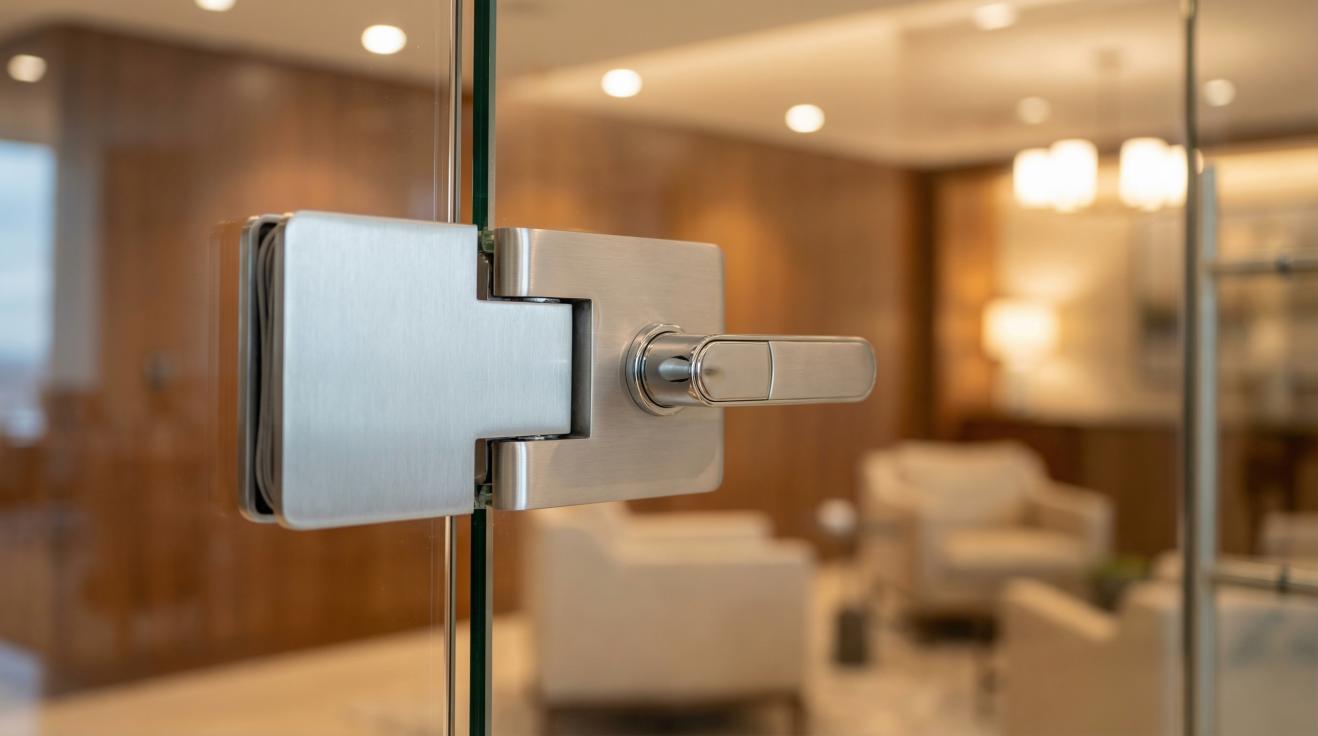
This guide explains how to power readers, smart glass, and sensors on glass office doors while keeping wiring hidden, reliable, and code-compliant.
You can power readers, smart glass, and sensors on glass office doors without ugly surface wires by using the frame, ceiling, and purpose-built connectors instead of sticking tape and cables on the glass. Done right, the door still looks premium while your access control, time clocks, and privacy tools keep working all day.
Every time a glass conference-room door slams shut and a taped-on wire pops loose, you pay for it in staff frustration, bad optics with clients, and lost minutes from people waiting to badge in or log hours. In offices that treat glass doors as part of the electrical design rather than a last-minute problem, a consistent playbook keeps readers online, privacy glass switching instantly, and doors closing smoothly for years. This guide walks through how to choose the right wiring strategy for your glass doors, route cables safely, and hide the whole system so the space still looks like the modern office you paid for.
Know Your Glass Door Before You Touch a Wire
Most office glass doors are built as heavy glass entrance systems with thick tempered or laminated glass panels hanging off precise hardware such as pivots, headers, and closers. That hardware only works properly when the opening is plumb and the hardware is firmly anchored. This type of glass is typically at least 3/8 inch thick and cannot be modified after fabrication, so drilling it later for cable holes is a fast way to crack a very expensive door and unbalance the hardware, which application guidelines for heavy glass entrances warn against when they stress accurate openings and careful hardware placement. Heavy glass entrance systems are engineered as a whole assembly, so you have to respect that system when you plan where wires will run.
Some interior doors use safety wire glass, where a grid of metal wire is embedded in the glass to hold shards together and provide specific fire ratings in the 20- to 90-minute range. That wired glass often sits in doors and sidelights that are part of a fire barrier governed by building and fire codes, which means changing frames, cutting new penetrations, or adding electrical components without proper planning can undermine both the rating and compliance. Guidance for safety wire glass emphasizes matching glass type and thickness to the required rating and treating frames, gaskets, and sealants as part of the tested assembly, so any wiring plan around a wired glass door needs to be coordinated with whoever is responsible for fire code on your project. Safety wire glass installation standards make it clear these openings are not a place for improvisation.
If you cannot change the glass itself, your options narrow in a good way: you will be working with the frame, jambs, ceiling, floor, and a few specialized devices to get power across the moving door leaf. Before talking about cable types, trace the hardware: note where the floor closer or pivot sits, whether there is a header or transom above the door, and whether there are metal frames around sidelites you can use as concealed raceways, since heavy glass systems rely on those supports for structural stability and hardware alignment. That quick survey tells you where you can safely drill metal or drywall and where you need to stay away from critical door mechanics.

Work With Frames, Jambs, and Ceilings Instead of the Glass
The simplest way to keep a glass office door clean is to treat the surrounding frame, jambs, and ceiling reveal as your primary cable routes, then cross the moving part only once with the right connector. Interior door specialists often treat door frames as functional cable highways, running wires inside or along the frame with slim trunking that matches the door's style and color so the whole assembly reads as one clean line instead of a mess of clips and tape. When you extend that logic to glass office doors, you start by asking where you can hide a small raceway or conduit in plain sight and coordinate its finish with the metal or wood around the glass.
In a framed glass office door with aluminum or steel stiles, the usual pattern is to bring power from above. You run low-voltage cable from the controller location up a wall, across the plenum or soffit, then down into the transom or header, which can often conceal both a transformer and wiring. From there you drop down the jamb and, only at the very end, cross the hinge or the sliding track. This is the same integrated approach promoted for interior doors where cable channels are chosen in wood, lacquered, or metallic finishes to match the door and trim, turning frames into discreet infrastructure rather than visual clutter.
On a completely frameless glass door hung between metal clamps or patch fittings, you usually do not get a hollow frame to hide wiring in, so you look upward. Many smart glass door installations place busbars, which are the copper strips that carry power into the smart film, along the top edge of the glass and then hide them inside a slim C-channel or metal cover that blends with the track or header. Manufacturers of smart glass doors highlight that this lets you keep cables out of sight while still providing a short, protected route into the door leaf for the final flexible connection. Smart glass and smart film door wiring is built around this idea of using the frame and track as your visual buffer.
From an operations standpoint, getting the cables into the frame and header first also protects the hardware that keeps your business moving. When people are rushing to badge into a time-tracking door reader or to reach a payroll office behind a glass door, every jerked cable is another support ticket. By hiding wiring in fixed framing and ceilings and only exposing it at one controlled crossing point, you reduce snag risks, make cleaning easier for the janitorial crew, and keep maintenance time away from your busiest doorways.
Choose How Power Crosses the Moving Door
Once cables are in the frame or track, the key decision is how power actually crosses the moving joint between the fixed structure and the glass door. There are only a few realistic options in a professional office setting, and each has very different tradeoffs in aesthetics, reliability, and how your devices behave when the door is open or closed.
Flexible Loops and Mini Power Loops
One common solution for sliding and swing glass doors is a mini power loop: a thin, flexible cable assembly mounted at the top of the door that forms a small loop as the door moves. Smart glass manufacturers describe versions that are less than 1/4 inch thick, rated to bend over a million cycles, and designed specifically to stay discreet while supplying power as the door opens and closes. In practice, you mount the frame side of the loop to the header or track cover, mount the door side near the top corner of the glass (ideally where a busbar is already hidden), and let the loop flex in a protected pocket above the clear line of sight. Sliding smart glass doors often rely on this style of connector to keep privacy film energized in any door position.
For a small business, this approach shines when you need the device powered while the door moves. Picture a glass HR office with switchable privacy glass controlled by a wall switch and a time-clock reader just outside. If the privacy glass loses power every time the door opens, the frosting may flicker between private and public at awkward moments. A mini power loop keeps power steady, avoids temporary outages, and still keeps most of the wiring tucked up above typical sightlines, which means the door looks like glass, not like a server rack.
Power Transfer Hinges
On swing doors with traditional hinges, a power transfer hinge replaces one of the existing hinges with a specialized hinge that contains an internal wiring channel from frame to door. Vendors working with smart glass doors call power transfer hinges the most elegant and simple solution, since wires disappear completely and the only visible difference is a slightly more substantial hinge that can cost around $400. That price often makes sense in spaces where the door is a focal point, such as executive offices or client-facing meeting rooms, because you get continuous power in any door position with no visible loop or boot and a very low risk of wire fatigue. Smart glass door wiring options highlight these hinges as the premium choice for aesthetics.
The catch is that anything touching hinges also touches life safety and hardware performance. You must coordinate power transfer hinge selection and installation with whoever supplied the door and frame, so you do not undermine weight ratings, clearances, or self-closing requirements. If the door is part of a rated fire or smoke barrier that uses wired glass, you also have to confirm that changing hardware or running wires inside the frame does not void the fire label on the assembly, something fire-door guides stress when they talk about matching all components to the tested configuration for that rating. Safety wire glass performance requirements make clear that glass, frame, and hardware work as a system.
Magnetic Contacts and Contact Plates
Another option is to avoid moving wires entirely and use magnetic contacts or contact plates that touch only when the door is closed. Smart glass suppliers describe sliding door setups where magnets in the door align with matching contacts in the frame so the privacy glass is powered only when the door is fully closed and the magnets line up. Automotive installers use a similar concept in aftermarket door-jamb contact systems for older cars: spring-loaded contacts in the jamb touch plates in the door to feed power, and as soon as the door opens, the connection breaks. Enthusiasts who have used these contact systems explain that the benefits include zero visible wiring between door and frame and no flexible loops to wear out, but the cost is that accessories lose power with the door open and the contacts need careful alignment and occasional cleaning to stay reliable. Door-jamb contact connectors are a clean look with built-in tradeoffs.
In an office, contacts make sense when whatever you are powering only needs to work when the door is closed. A classic example is a glass conference room door where privacy glass should only be opaque when the door is shut, or an indicator light that shows the room is occupied. For access control readers or anything involved in time and attendance, contact systems are usually the wrong choice, because you need those devices operating regardless of door position so employees can badge in and out without waiting for a perfectly closed door.
Flexible Boots and Braided Looms on Framed Doors
Where a glass door has wide metal stiles or is part of a glass-within-metal door leaf, you can sometimes borrow ideas from automotive practice and install a flexible rubber boot or braided loom between the metal edge of the door and the metal jamb. Car builders talk about using OEM-style rubber boots with staggered holes in the door and jamb so the door's swing gently bends the boot without chafing the wires, and they check moving parts like windows to ensure they do not hit the loom. Some go with braided stainless looms that slide through metal bosses, achieving a custom, somewhat industrial look while keeping wiring protected. Door-jamb wiring discussions make it clear that hole placement, adequate clearance, and strain relief matter more than the specific brand of loom.
In glass offices, these looms are rarely the first choice because they look more mechanical than many designers want, but they can be a reasonable option on back-of-house doors where durability matters more than polish. If you have a warehouse-to-office glass door that only staff see and you need to feed a heavy-duty door contact and reader, a rubber boot at knee height may bother you far less than a failed reader on payroll Monday.

Comparing the Main Wiring Options
Method |
Best for door type |
Visual impact |
Key pros |
Key cons |
Mini power loop |
Sliding or swing glass doors |
Small loop near top, subtle |
Continuous power, thin, proven flex cycles |
Slightly visible, needs top clearance |
Power transfer hinge |
Swing doors with hinges |
Virtually invisible |
Fully hidden wires, continuous power |
Higher cost, hardware and code coordination |
Magnetic contacts |
Sliding or swing doors |
No moving wires visible |
Clean look, no flexing cables |
No power when open, requires precise alignment |
Rubber boot/loom |
Framed metal doors |
Visible between door and jamb |
Durable, protects wires |
More industrial look, careful hole placement |
This comparison makes the choice easier. If your door is client-facing and the device must work open or closed, you lean toward power transfer hinges or mini loops. If you only care about closed-door behavior and want a gallery-clean look, magnetic contacts may be worth the operational tradeoff.

Keep It Safe, Code-Compliant, and Door-Friendly
Any wiring plan that fights the door hardware will cost you more than it saves. Heavy glass entrance guidelines repeatedly stress that closers and pivots must be set plumb and level, and floors and headers must be square, or doors will bind and fail to latch properly, especially at locking points. When you add cabling, you need to preserve that geometry by keeping raceways out of the swing path, leaving clearance around top pivots and floor closers, and never using a cable or loop as a makeshift stop. Glass entrance system guidance treats door motion as nonnegotiable; your wiring should do the same.
Fire-rated glass doors add another layer of constraint. Safety wire glass used in stairwells, corridors, and other egress paths is evaluated against standards such as ANSI Z97.1 and CPSC 16 CFR 1201, and it relies on the combination of glass, frame, gaskets, and sealants to deliver its rated performance. Installation resources for wired glass emphasize measuring openings with a small tolerance to allow for thermal expansion, setting panels without pressure points, and sealing continuously around edges to block air and moisture movement, which can affect both fire and safety performance. Safety wire glass code requirements implicitly warn that drilling frames randomly or stuffing cables into glazing pockets is a shortcut that can backfire during inspections or, worse, during an actual fire.
From an operations standpoint, a little planning can be worth an hour of payroll every week. Imagine twenty people lining up at a glass office entrance with a badge reader whose cable has been pinched by a misplaced raceway; if each person loses three minutes getting in, that is a full hour of paid time gone in a single morning. The cost of a proper power transfer hinge or a professionally installed mini loop is tiny compared with the cumulative drag of those micro-delays, not to mention the headaches of manual time corrections when readers fail.

A Practical Planning Walkthrough
Take a typical use case: a glass-front HR and payroll office where the door needs a card reader outside, a smart glass panel for privacy during sensitive conversations, and a sensor inside to tie into your access control system. The cleanest pattern is to plan backward from the devices. You start by placing the reader at a comfortable hand height outside the frame and the smart glass busbar along the top of the door where it can be hidden by a C-channel or header cover.
Next, you choose the crossing method based on door type. If it is a swing door with metal jambs and you can coordinate with the door supplier, a power transfer hinge gives you continuous power in any door position and a completely clean glass surface. If it is a sliding door with a ceiling-mounted track and no traditional hinges, a mini power loop at the top of the glass tied back to the track cover typically gives you the best blend of aesthetics and reliability. In both cases, your cables run from the access control panel up the wall, across the ceiling or plenum, down into the header or track, and then across the moving joint through the hinge or loop.
Before calling the electrician, you dry-run the mechanical side. Open the door fully and watch where the header, top of the glass, and any existing hardware move, then sketch the cable path so it stays clear of closers, lock bodies, and high-wear areas. Only after that do you have the electrician bring power into the header or nearby junction box, connect transformers, and feed low-voltage control wiring through your planned paths. Smart glass suppliers recommend that a certified electrician handle the connection from transformers to mains while low-voltage connections from glass to controller can sometimes be handled by trained low-voltage technicians, especially when wiring is pre-terminated from the factory.
Finally, you test it like a user, not an installer. Have someone badge in during a mock rush, open and close the door several dozen times, and switch the privacy glass on and off as you watch the loops, hinges, and cables. If anything rubs, snaps taut, or looks like a cleaning cloth could catch it, fix it now instead of waiting for the next payroll crunch to expose the weak point.
FAQ
Can I just run a low-profile cable across the glass and hide it with frosted film later?
You can, but it is almost always a short-term hack. Adhesives age, cleaning chemicals attack tape and film edges, and cables exposed on the glass are far more likely to be snagged by bags, carts, or cleaning tools. On any door that uses safety wire glass or has a fire rating, applying untested films and adhesives can also interfere with how the assembly behaves in heat, which is why wired glass resources stress carefully chosen sealants and installation methods rather than ad hoc coverings around the glass.
Do I really need an electrician for low-voltage smart glass or door devices?
Most smart glass and smart film systems operate on low voltage after a transformer, and manufacturers note that connecting those pre-wired glass panels to their controller is closer to plugging in a device than wiring a panel. However, any connection from that transformer to building power should be done by a certified electrician, and in many jurisdictions that is not optional. When you are tying into access control and time-tracking systems that matter for payroll accuracy and security, it is worth letting a licensed professional handle the mains side while you focus on planning clean cable paths that respect the door hardware and the look of the space.
When you treat glass office doors as part of your infrastructure, not just decor, you get quieter hallways, sharper-looking spaces, and doors that work as reliably as your best employees. Plan the cable path early, choose the right crossing hardware for each door, and you will keep smart locks, readers, and privacy glass out of sight and out of mind, exactly where good wiring belongs.


Share:
Door Didn't Unlock During a Power Outage? Check Fail-Safe Settings
Video Intercom vs. Audio Only: Does a Small Office Need Video Features?